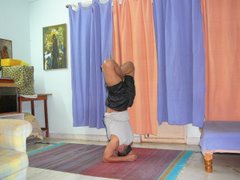
Approaching Ardha Matsyendrasana
Ardha (n.) = Half
Matsya (n.) = Fish
Indra (n.) = King
Asana (n.) = Pose
Though transliterating this Asana may be called as King of fish pose, it is not called in such a way. The Asana has been invented by a sage named Matsyendranath, and hence is named after him.
The Asana does exert pressure on the Pancreas which is responsible for secretion of the hormone insulin that regulates the blood sugar.
Hence Matsyendrasana is excellent for fighting diabetes. The above figure illustraes an approach to achieving the Ardha Matsyendrasana, which is a difficult Asana in itelf. In the next few posts, I shall publish the approach and finally reach the Ardha Matsyendrasana.
Showing posts with label Yoga for Back Pain. Show all posts
Tuesday, September 1, 2009
Saturday, January 17, 2009
Kapotasana
Wednesday, April 16, 2008
Ardha Halasana
Ardha Halasana
Ardha (n.) = Half
Hala (n.) = Plough
Asana (n.) = Posture
Balarama brother of Krishna in Mahabharata (Devaki and Vasudeva's son but who was born in Rohini's womb by somethe miraculous method which sounds like embryo transplantation procedure of today's medical science) was called Haladhara - who holds or carries a plough. Balarama's weapon was a plough.
I talked about this simple, yet so beneficial Asana for treating back pain last year. I practiced this Asana and got wonderful results. Of course, if you have acute back pain, so much so that lifting legs like this is painful. In which case desist doing this Asana. I went through this acute pain too :). With time, and as a result of doing other back pain Asanas as pain is reduced, you can start doing this one.
Ardha (n.) = Half
Hala (n.) = Plough
Asana (n.) = Posture
Balarama brother of Krishna in Mahabharata (Devaki and Vasudeva's son but who was born in Rohini's womb by somethe miraculous method which sounds like embryo transplantation procedure of today's medical science) was called Haladhara - who holds or carries a plough. Balarama's weapon was a plough.
I talked about this simple, yet so beneficial Asana for treating back pain last year. I practiced this Asana and got wonderful results. Of course, if you have acute back pain, so much so that lifting legs like this is painful. In which case desist doing this Asana. I went through this acute pain too :). With time, and as a result of doing other back pain Asanas as pain is reduced, you can start doing this one.
Saturday, March 22, 2008
Supta Padangusthasana
Supta (adj.) = Asleep
Pada (n.) = Leg
Angushtha (n.) = Thumb
Asana (n.) = Posture
Together the above should mean "Lying big toe posture"
I find this Asana to be one of most difficult in the Padangusthasana series. It really is the graduating Asana in the series. There's only one which I can think of more challenging than or as challenging as this Asana which is Parsha Padangusthasana.
Right Leg
As ususal, I still have a lot to achieve in this Asana (I am just a student :)) - the comfort that I seek while practicing this Asana, I hope would come in about a year or thereabouts.
Left Leg
Breathing: Breathe in as the legs are extended
Drishti: Nasagre
Supta (adj.) = Asleep
Pada (n.) = Leg
Angushtha (n.) = Thumb
Asana (n.) = Posture
Together the above should mean "Lying big toe posture"
I find this Asana to be one of most difficult in the Padangusthasana series. It really is the graduating Asana in the series. There's only one which I can think of more challenging than or as challenging as this Asana which is Parsha Padangusthasana.
Right Leg
As ususal, I still have a lot to achieve in this Asana (I am just a student :)) - the comfort that I seek while practicing this Asana, I hope would come in about a year or thereabouts.
Left Leg
Breathing: Breathe in as the legs are extended
Drishti: Nasagre
Thursday, March 6, 2008
Nirlamba Sarpasana
Nirlamba Sarpasana
Nirlamba (adj.) = Without support
Sarpa (n.) = Snake
Asana (n.) = Posture
Quite a few days ago I published the Bhujangasana. Nirlamba Sarpasana is the next step to it.
Everything remains the same - the breathing, the drishti.
Nirlamba (adj.) = Without support
Sarpa (n.) = Snake
Asana (n.) = Posture
Quite a few days ago I published the Bhujangasana. Nirlamba Sarpasana is the next step to it.
Everything remains the same - the breathing, the drishti.
Sunday, February 24, 2008
Approaching Matsyasana - Part II
Well, this manuever helped me in Matsyasana practice, as well as in Kukkutasana and Garbhapindasana practice. It also helped me in the Karandavasana practice.
It also helped me in a big way to get rid of the back pain.
The good news... thanks to my relentless practice of Yoga, the back pain is almost gone. So much so that, the other day I tried to do the Sarvangasana - and wonder of wonders, I felt no pain. Have been doing Sarvangasana since then regularly.
Well, this manuever helped me in Matsyasana practice, as well as in Kukkutasana and Garbhapindasana practice. It also helped me in the Karandavasana practice.
It also helped me in a big way to get rid of the back pain.
The good news... thanks to my relentless practice of Yoga, the back pain is almost gone. So much so that, the other day I tried to do the Sarvangasana - and wonder of wonders, I felt no pain. Have been doing Sarvangasana since then regularly.
Labels:
Matsyasana,
practice,
Yoga for Back Pain
Sunday, February 17, 2008
Saral Dhanurasana
Saral Dhanurasana
Saral(adj.) = Simple
Dhanuh(n.) = Bow
Asana(n.) = Posture
It's quite sometime ago I published the Dhanurasana. I talked about Saral Dhanurasana but did not publish the same in that post. However, a few visitors actually came to the site looking for that pose.
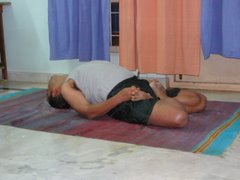
Here you go dear visitors.
As I mentioned earlier, even this Saral Dhurasana may be difficult for some - particularly, I have seen people not able to catch hold of their legs.
Drishti: on the third eye
Breathing: inhale while raising head from the ground. Normal as you hold the position.
Saral(adj.) = Simple
Dhanuh(n.) = Bow
Asana(n.) = Posture
It's quite sometime ago I published the Dhanurasana. I talked about Saral Dhanurasana but did not publish the same in that post. However, a few visitors actually came to the site looking for that pose.
Here you go dear visitors.
As I mentioned earlier, even this Saral Dhurasana may be difficult for some - particularly, I have seen people not able to catch hold of their legs.
Drishti: on the third eye
Breathing: inhale while raising head from the ground. Normal as you hold the position.
Tuesday, September 11, 2007
Yoga for Back Pain (Concluding Part) - Ardha Chakrasana
Ardha Chakrasana (the Arch)
Ardha = half
Chakra = wheel, or the disc used as weapon by Krishna, the character in Mahabharata the epic of India

Self-critique: I am no good at all in this asana. Culprit is my poorly joined left arm after a near fatal accident quite a long time ago. As also some kind of nodular problem in the tendon sheath of the right wrist - which makes it very difficult and painful to support my body weight on the right wrist. Hence the arms are never straight as they should be. Hopefully Yoga will help me get over these problems in time to come.
Comments: This concludes the back pain series in Asana. Exclusions are the pranayama part. I did not intend to cover them in this series though they are as effective, if not more, in relieving back pain.
Ardha = half
Chakra = wheel, or the disc used as weapon by Krishna, the character in Mahabharata the epic of India
Self-critique: I am no good at all in this asana. Culprit is my poorly joined left arm after a near fatal accident quite a long time ago. As also some kind of nodular problem in the tendon sheath of the right wrist - which makes it very difficult and painful to support my body weight on the right wrist. Hence the arms are never straight as they should be. Hopefully Yoga will help me get over these problems in time to come.
Comments: This concludes the back pain series in Asana. Exclusions are the pranayama part. I did not intend to cover them in this series though they are as effective, if not more, in relieving back pain.
Saturday, September 8, 2007
Yoga for Back Pain (Part20) - Kavandhasana
Kavandhasana
This asana is easier version of the Ardha Chakrasana. People who find difficult to do the Arch (Ardha chakrasana) could do this.
Kavandha (n.)= headless torso.
Some call this Kandharasana = shoulder Asana. Apart from back pain, this Asana is good for Hypothyroidism too. Since it exerts pressure on the thyroid glands.
The shoulder Stand, Sarvangasana too does the same and of course does something more - which is: help the flow of blood to the neck and face region. But then people with back pain must not do a shoulder stand. I did, that for a long time :). And suffered because of this folly. :).
This asana is easier version of the Ardha Chakrasana. People who find difficult to do the Arch (Ardha chakrasana) could do this.
Kavandha (n.)= headless torso.
Some call this Kandharasana = shoulder Asana. Apart from back pain, this Asana is good for Hypothyroidism too. Since it exerts pressure on the thyroid glands.
The shoulder Stand, Sarvangasana too does the same and of course does something more - which is: help the flow of blood to the neck and face region. But then people with back pain must not do a shoulder stand. I did, that for a long time :). And suffered because of this folly. :).
Friday, September 7, 2007
Yoga for Back Pain (Part19) - Dhanurasana
Dhanurasana
Dhanu = bow,
Dhanu has other Sanskrita synonyms too, Kodanda for example
I am not giving the Saral Dhanurasana before this Dhanurasana here.
For Saral Dhanurasana visit this page. Here one just holds the legs; and the knees are not raised from the ground. Perfect for those who are just beginning in the Yoga voyage. And for people for whom years of unuse of the spine has made it so stiff that raising the legs would be a trouble. I have even seen people who find even holding the legs quite difficult. In which case Bhujangasana is the best way to start to gradually proceed to Dhanurasana.

Drishti: Bhru-Madhye( middle of the eye brows)
Focus: Waist
Breathing: in while raising the body from the ground, normal, deep and slow while holding the pose, and out while lowering the body to the original position.
Dhanu = bow,
Dhanu has other Sanskrita synonyms too, Kodanda for example
I am not giving the Saral Dhanurasana before this Dhanurasana here.
For Saral Dhanurasana visit this page. Here one just holds the legs; and the knees are not raised from the ground. Perfect for those who are just beginning in the Yoga voyage. And for people for whom years of unuse of the spine has made it so stiff that raising the legs would be a trouble. I have even seen people who find even holding the legs quite difficult. In which case Bhujangasana is the best way to start to gradually proceed to Dhanurasana.
Drishti: Bhru-Madhye( middle of the eye brows)
Focus: Waist
Breathing: in while raising the body from the ground, normal, deep and slow while holding the pose, and out while lowering the body to the original position.
Thursday, September 6, 2007
Yoga for Back Pain (Part18) Salavasana (both legs)
Salavasana (both legs)
Warning!!!:
1) the usual warning for back bending asana - hernia etc. patients not to practise it
2) For people who have a really bad back, do not lift both your legs together with a jerk. But perform one legged salavasana (as in back pain issue number 17, and then smoothly lift the other leg, so that there are no jerks to the waist).

Breathing and other things are as in back pain - 17.
Warning!!!:
1) the usual warning for back bending asana - hernia etc. patients not to practise it
2) For people who have a really bad back, do not lift both your legs together with a jerk. But perform one legged salavasana (as in back pain issue number 17, and then smoothly lift the other leg, so that there are no jerks to the waist).
Breathing and other things are as in back pain - 17.
Wednesday, September 5, 2007
Yoga for Back Pain (Part17) Salavasana (One Legged Version)
Salavasana (One Legged Version)

Warning: This asana is a back bending Asana. Hence must not be performed by people who must not perform any other back bending asana
Breathing: As usual inhale while raising legs, exhale while putting legs down. Normal deep breathing as you hold the Asana
Drishti: Bhru-Madhye (in the middle of the eye brows)
Focus: Waist
Warning: This asana is a back bending Asana. Hence must not be performed by people who must not perform any other back bending asana
Breathing: As usual inhale while raising legs, exhale while putting legs down. Normal deep breathing as you hold the Asana
Drishti: Bhru-Madhye (in the middle of the eye brows)
Focus: Waist
Tuesday, September 4, 2007
Monday, September 3, 2007
Yoga for Back Pain (Part15) Bhujangasana
Bhujangasana
Bhuja (n.) = Arms
Anga (n.) = Body
Asana (n.) = Posture
Bhuja anga means someone whose body is the arms - which is snake. This is because snakes use their body as their arm - for example, arms are used to hold, grasp - their body is used exactly for that purpose.

This Asana is quite simple, much like the saral (easy version) which is given in the earlier post. Only that there are some people who may not do any of such Asanas which call for backward bending - Particurly people of Hernia, heart disease etc.
Drishti: (Bhru madhye) the middle of the eyebrows
Focus: the waist or the back
Bhuja (n.) = Arms
Anga (n.) = Body
Asana (n.) = Posture
Bhuja anga means someone whose body is the arms - which is snake. This is because snakes use their body as their arm - for example, arms are used to hold, grasp - their body is used exactly for that purpose.
This Asana is quite simple, much like the saral (easy version) which is given in the earlier post. Only that there are some people who may not do any of such Asanas which call for backward bending - Particurly people of Hernia, heart disease etc.
Drishti: (Bhru madhye) the middle of the eyebrows
Focus: the waist or the back
Saturday, September 1, 2007
Yoga for Back Pain (Part14) Saral Bhujangasana
Saral Bhujangasana

With this Asana starts the backbending asanas that provide good results against back pain.
Back pain causes may be various. Bad sitting posture, a job that requires standing always - such as that of a traffic police, soft mattress. And there could be medical cause too - such as excess uric acid in the blood which may cause rheumatism in the pelvis or the back.
This Asana focuses on the back muscles, and the spinal cord and strengthens them. It also strengthens the two columns of stomach muscles (the rectus abdominis and the obliques) and the internal stomach organs consequently. hence, there is a greater chance of getting rid of the back pain by getting rid of excess uric acid production in the stomach.
Focus: manipura chakra
Drishti: ajna chakra (between the eye-brows).
With this Asana starts the backbending asanas that provide good results against back pain.
Back pain causes may be various. Bad sitting posture, a job that requires standing always - such as that of a traffic police, soft mattress. And there could be medical cause too - such as excess uric acid in the blood which may cause rheumatism in the pelvis or the back.
This Asana focuses on the back muscles, and the spinal cord and strengthens them. It also strengthens the two columns of stomach muscles (the rectus abdominis and the obliques) and the internal stomach organs consequently. hence, there is a greater chance of getting rid of the back pain by getting rid of excess uric acid production in the stomach.
Focus: manipura chakra
Drishti: ajna chakra (between the eye-brows).
Friday, August 31, 2007
Yoga for Back Pain (Part13) Tolangulasana (variation2)
Thursday, August 30, 2007
Yoga for Back Pain (Part12) Tolangulasana (variation1)
Tolangulasana (variation1)

Comments: Well, this is a slightly varied version of the regular Tolangulasana (which means the balance scale) - the back is raised from the ground in the regular version, and the butt acts as a fulcrum on which the entire body hangs in balance.
Whereas in this variation, only the head and neck are raised from the ground, while the rest of the back (shoulder to pelvis) lies firmly on the ground)
This variation of Tolangulasana works well in back pain.
Breathing: while raising the body breathe in. Holding the position breathe normal, deep and slow. lowering the body and the legs - breathe out.
Focus: Neck and waist (the Bishuddhi and the Swadhishthana chakra)
Drishti: Nasagre (nosetip).
Comments: Well, this is a slightly varied version of the regular Tolangulasana (which means the balance scale) - the back is raised from the ground in the regular version, and the butt acts as a fulcrum on which the entire body hangs in balance.
Whereas in this variation, only the head and neck are raised from the ground, while the rest of the back (shoulder to pelvis) lies firmly on the ground)
This variation of Tolangulasana works well in back pain.
Breathing: while raising the body breathe in. Holding the position breathe normal, deep and slow. lowering the body and the legs - breathe out.
Focus: Neck and waist (the Bishuddhi and the Swadhishthana chakra)
Drishti: Nasagre (nosetip).
Wednesday, August 29, 2007
Yoga for Back Pain (Part11) Nasa-sparsasana
Nasa-sparsasana
Nasa = nose
sparsha = touch
Asana = posture
As is quite understandable from the name, the idea is to touch the nose with one's toes.
This is an excellent Asana for treating the back pain.

Breathing: 1) breathe in while pulling the leg to the nose 2) breathe normally slow and deep as you hold the posture 3) Breathe out as you release the leg to its earlier position.
Below is a side view of the same Asana
Nasa = nose
sparsha = touch
Asana = posture
As is quite understandable from the name, the idea is to touch the nose with one's toes.
This is an excellent Asana for treating the back pain.
Breathing: 1) breathe in while pulling the leg to the nose 2) breathe normally slow and deep as you hold the posture 3) Breathe out as you release the leg to its earlier position.
Below is a side view of the same Asana
Tuesday, August 28, 2007
Yoga for Back Pain (Part 10) Utthitapadasana (both legs)
Utthitapadasana (both legs)
Utthita(adj.) = which has been raised. utthan(v.) = raise or rise
(Antonym)Patita(adj.) = fallen, downtrodden
Pada(n.) = leg or foot
Asana = posture
Warning!!:
i) For people with severe back pain, do it with help of an expert. Lifting both legs together could be jerky, which one must avoid.
ii) the smoothness of the lift will depend on the strength of your stomach muscles (rectus abdominis and oblique).
iii) Sudden Impact in the stomach muscles exerts an opposite and equal reaction in the back - around the spinal column. Hence exerting too much force in the stomach muscle to keep the legs raised for a longer time than which is comfortable harms rather than cures the back pain.

Breathing:
i) Breathe in while raising the legs, out while putting them down.
ii)Regular deep and slow breathing. Hold the position for 5 breaths for beginners, or till the time you are comfortable of holding the position. When you start feeling effort in keeping the position or breathing hard, lower your legs.
Comments: I have this photo with my stomach uncovered to show how the stomach muscles contract while holding this pose and breathing regularly.
Utthita(adj.) = which has been raised. utthan(v.) = raise or rise
(Antonym)Patita(adj.) = fallen, downtrodden
Pada(n.) = leg or foot
Asana = posture
Warning!!:
i) For people with severe back pain, do it with help of an expert. Lifting both legs together could be jerky, which one must avoid.
ii) the smoothness of the lift will depend on the strength of your stomach muscles (rectus abdominis and oblique).
iii) Sudden Impact in the stomach muscles exerts an opposite and equal reaction in the back - around the spinal column. Hence exerting too much force in the stomach muscle to keep the legs raised for a longer time than which is comfortable harms rather than cures the back pain.
Breathing:
i) Breathe in while raising the legs, out while putting them down.
ii)Regular deep and slow breathing. Hold the position for 5 breaths for beginners, or till the time you are comfortable of holding the position. When you start feeling effort in keeping the position or breathing hard, lower your legs.
Comments: I have this photo with my stomach uncovered to show how the stomach muscles contract while holding this pose and breathing regularly.
Monday, August 27, 2007
Yoga for Back Pain (Part 9) Utthitapadasana
Utthitapadasana (one legged version)

The secondary focus of Utthanpadasana and that of Utthitapadasana are different. For the former it is the hamstring, pelvis. For the latter it is the stomach (the rectus abdominis and the obliques muscles of the stomach) and the alignment of chest and shoulder.
The primary focus of course remains the back and pelvis alignment with earth.
Breathing: As always breath in, while raising leg. Breath normally, deep and slow, while you are holding the pose for 20 breaths, and breath out as you bring the leg down.
The secondary focus of Utthanpadasana and that of Utthitapadasana are different. For the former it is the hamstring, pelvis. For the latter it is the stomach (the rectus abdominis and the obliques muscles of the stomach) and the alignment of chest and shoulder.
The primary focus of course remains the back and pelvis alignment with earth.
Breathing: As always breath in, while raising leg. Breath normally, deep and slow, while you are holding the pose for 20 breaths, and breath out as you bring the leg down.
Subscribe to:
Posts (Atom)