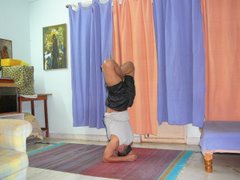
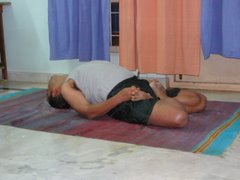
Approaching Ardha Matsyendrasana
Ardha (n.) = Half
Matsya (n.) = Fish
Indra (n.) = King
Asana (n.) = Pose
Though transliterating this Asana may be called as King of fish pose, it is not called in such a way. The Asana has been invented by a sage named Matsyendranath, and hence is named after him.
The Asana does exert pressure on the Pancreas which is responsible for secretion of the hormone insulin that regulates the blood sugar.
Hence Matsyendrasana is excellent for fighting diabetes. The above figure illustraes an approach to achieving the Ardha Matsyendrasana, which is a difficult Asana in itelf. In the next few posts, I shall publish the approach and finally reach the Ardha Matsyendrasana.
Showing posts with label practice. Show all posts
Tuesday, September 1, 2009
Friday, May 9, 2008
Sarvangasana
Sarvangasana
Sarva (n.) = All
Anga (n.) = Limb
Asana (n.) = Posture
Together these words will mean the posture which exercises all limbs
Self Critique:
Well, thanks to my back pain which is almost gone now, I have not been doing this Asana or any other forward bending Asana for a long time. As I reported sometime earlier, I recently started doing Sarvangasana regularly. But years of non-practice has led to reduce the quality that I seek in everything. First defect in this posture that I see, that the body is not as perpendicular to the ground as I would like it to be. Second, the weight of the body is still borne by wrists and hands here - the force applied by the hands and the waists can be clearly seen. Ideally, the palms should merely rest on the back, they should not exert pressure of the waist to hold the torso straight.
Breathing: Breathe in as you raise the legs to the position, breathe normal as you hold the position, and breathe out as you lower the limbs to the ground.
How to execute the posture:
1) Lie in Savasana
2) perform Ardha halasana
3) Raise your back from the ground with the help of the hands and legs moving from Ardha halasana without resting and in one sweeping motion
Sarva (n.) = All
Anga (n.) = Limb
Asana (n.) = Posture
Together these words will mean the posture which exercises all limbs
Self Critique:
Well, thanks to my back pain which is almost gone now, I have not been doing this Asana or any other forward bending Asana for a long time. As I reported sometime earlier, I recently started doing Sarvangasana regularly. But years of non-practice has led to reduce the quality that I seek in everything. First defect in this posture that I see, that the body is not as perpendicular to the ground as I would like it to be. Second, the weight of the body is still borne by wrists and hands here - the force applied by the hands and the waists can be clearly seen. Ideally, the palms should merely rest on the back, they should not exert pressure of the waist to hold the torso straight.
Breathing: Breathe in as you raise the legs to the position, breathe normal as you hold the position, and breathe out as you lower the limbs to the ground.
How to execute the posture:
1) Lie in Savasana
2) perform Ardha halasana
3) Raise your back from the ground with the help of the hands and legs moving from Ardha halasana without resting and in one sweeping motion
Wednesday, April 23, 2008
Approaching Baddha Padmasana
Baddha(adj.) = Bound
Padma (n.) = Lotus
Asana (n.) = Posture
Baddha Padmasana is one of those Asanas that work on the shoulders,chest, back, stomach, genitals, arms, figures, legs, knees. Now, for a beginner this Asana is tough. The puzzles to solve here is how to get those arms sneak around the back and catch hold of the big toes?
I heard such solutions as "your arms/legs are proportionally longer than those of mine". Not quite sir, it's a three piece puzzle.
i) Straighten the back - this is the last piece actually
ii) Increase the reach of your arms - by exercising your back muscles and the ball and socket of your shoulders
iii) Learn to do a tight Padmasana - by moving the foot touch your waist region
In here we are dealing with the second problem.
See? Hold the fingers of your right hand by your left hand and continuously exert a pulling pressure on it. Count twenty breaths. Release your arms lock. Now do the same stuff changing your arms - exert a pulling pressure on the fingers of left hand by your right.
Baddha(adj.) = Bound
Padma (n.) = Lotus
Asana (n.) = Posture
Baddha Padmasana is one of those Asanas that work on the shoulders,chest, back, stomach, genitals, arms, figures, legs, knees. Now, for a beginner this Asana is tough. The puzzles to solve here is how to get those arms sneak around the back and catch hold of the big toes?
I heard such solutions as "your arms/legs are proportionally longer than those of mine". Not quite sir, it's a three piece puzzle.
i) Straighten the back - this is the last piece actually
ii) Increase the reach of your arms - by exercising your back muscles and the ball and socket of your shoulders
iii) Learn to do a tight Padmasana - by moving the foot touch your waist region
In here we are dealing with the second problem.
See? Hold the fingers of your right hand by your left hand and continuously exert a pulling pressure on it. Count twenty breaths. Release your arms lock. Now do the same stuff changing your arms - exert a pulling pressure on the fingers of left hand by your right.
Thursday, April 3, 2008
Bharadwajasana
Bharadwajasana
Alternate spelling: Bharadvajasana
This Asana has been named after Sage Bharadwaja
Who was sage Bharadwaja?
Sage Bharadwaja belongs to the Brahmin clan which was known for its physical activities and practice of the martial arts. He was the father of sage Dronacharya, the teacher of the Pandavas and Kauravas in Mahabharata.
The birth of Drona is quite interesting which has been recounted in the Mahabharata quite elaborately. Since in this case Drona was not born out of a woman, but a clay pot.
Sage Bharadwaja's other son was sage Garga - who was also a vedic scholar as his father. Garga was also a renowned astrologer who gave Krishna his name.
I found this Asana very useful in progressing to Ardha-Matsyedrasana
Breathing: Breath in when twisting the torso to the back. I am still, as usual, still to go a long way grappling this Asana. The twist here should be even more pronounced.
Alternate spelling: Bharadvajasana
This Asana has been named after Sage Bharadwaja
Who was sage Bharadwaja?
Sage Bharadwaja belongs to the Brahmin clan which was known for its physical activities and practice of the martial arts. He was the father of sage Dronacharya, the teacher of the Pandavas and Kauravas in Mahabharata.
The birth of Drona is quite interesting which has been recounted in the Mahabharata quite elaborately. Since in this case Drona was not born out of a woman, but a clay pot.
Sage Bharadwaja's other son was sage Garga - who was also a vedic scholar as his father. Garga was also a renowned astrologer who gave Krishna his name.
I found this Asana very useful in progressing to Ardha-Matsyedrasana
Breathing: Breath in when twisting the torso to the back. I am still, as usual, still to go a long way grappling this Asana. The twist here should be even more pronounced.
Labels:
Ardha Matsyendrasana,
Intermediate Asana,
practice
Thursday, March 27, 2008
Vatayanasana
Vatayanasana
Vata (n.) = Wind, air, breeze
Ayana (n.) = Direction, Phase
Vatayana (n.) = Window
Asana (n.) = Posture
Now, why this particular Asana is named in this way, I am not sure. Does it have something to do with wind such as Pavanmuktasana has? Not sure again.
Breathing: Inhale as you raise your arm (picture above), exhale as you touch your toes (picture below)
Well, I have given it a practice label, since, I am only tentatively doing forward bends these days. Didn't do it for more than two years - courtesy my back pain. As the back pain recedes, reclaims my forward bend its lost territory. yet, I have miles to go in here too. Not only the finger tip will touch the ground, but the full plain of the palm (karatal)
Vata (n.) = Wind, air, breeze
Ayana (n.) = Direction, Phase
Vatayana (n.) = Window
Asana (n.) = Posture
Now, why this particular Asana is named in this way, I am not sure. Does it have something to do with wind such as Pavanmuktasana has? Not sure again.
Breathing: Inhale as you raise your arm (picture above), exhale as you touch your toes (picture below)
Well, I have given it a practice label, since, I am only tentatively doing forward bends these days. Didn't do it for more than two years - courtesy my back pain. As the back pain recedes, reclaims my forward bend its lost territory. yet, I have miles to go in here too. Not only the finger tip will touch the ground, but the full plain of the palm (karatal)
Saturday, March 22, 2008
Supta Padangusthasana
Supta (adj.) = Asleep
Pada (n.) = Leg
Angushtha (n.) = Thumb
Asana (n.) = Posture
Together the above should mean "Lying big toe posture"
I find this Asana to be one of most difficult in the Padangusthasana series. It really is the graduating Asana in the series. There's only one which I can think of more challenging than or as challenging as this Asana which is Parsha Padangusthasana.
Right Leg
As ususal, I still have a lot to achieve in this Asana (I am just a student :)) - the comfort that I seek while practicing this Asana, I hope would come in about a year or thereabouts.
Left Leg
Breathing: Breathe in as the legs are extended
Drishti: Nasagre
Supta (adj.) = Asleep
Pada (n.) = Leg
Angushtha (n.) = Thumb
Asana (n.) = Posture
Together the above should mean "Lying big toe posture"
I find this Asana to be one of most difficult in the Padangusthasana series. It really is the graduating Asana in the series. There's only one which I can think of more challenging than or as challenging as this Asana which is Parsha Padangusthasana.
Right Leg
As ususal, I still have a lot to achieve in this Asana (I am just a student :)) - the comfort that I seek while practicing this Asana, I hope would come in about a year or thereabouts.
Left Leg
Breathing: Breathe in as the legs are extended
Drishti: Nasagre
Wednesday, March 19, 2008
Naukasana
Naukasana
Nauka (n.) = Boat
Asana (n.) = Posture
Naukasana is also known as Navasana. But the latter, I feel, is a Hindi, and not a Sankrita word.
Hence I prefer to call it as Naukasana
One friend asked me how to do a Naukasana. I assume that it would be in the mind of my visitors too. Well, I have seen multiple ways of doing this Asana. However, the easiest way I find is as provided below:
1. Sit with your back straight
2. Extend both your legs forward as you would when you are doing the Paschimottanasana
3. Place your hands, palm down on yor knees;
4. Breathe in
5. Breathe out and tilt backwards, and extend your arms towards the knees
Nauka (n.) = Boat
Asana (n.) = Posture
Naukasana is also known as Navasana. But the latter, I feel, is a Hindi, and not a Sankrita word.
Hence I prefer to call it as Naukasana
One friend asked me how to do a Naukasana. I assume that it would be in the mind of my visitors too. Well, I have seen multiple ways of doing this Asana. However, the easiest way I find is as provided below:
1. Sit with your back straight
2. Extend both your legs forward as you would when you are doing the Paschimottanasana
3. Place your hands, palm down on yor knees;
4. Breathe in
5. Breathe out and tilt backwards, and extend your arms towards the knees
Sunday, March 16, 2008
Supta Urdha Pada Vajrasana
Supta (adj.) = Asleep
Urdha (n./adj.) = High
Pada (n.) = Leg
Vajra (n.) = Thunder
Asana (n.) = Posture
In this pose I am entering into the Supta Urdha Pada Vajrasana. The full Supta Urdha Pada Vajrasana is much tougher, and is not shown here. Let me overcome the challeges in this Vinyasa entry, then perhaps I shall be able to do that Asana.
Supta (adj.) = Asleep
Urdha (n./adj.) = High
Pada (n.) = Leg
Vajra (n.) = Thunder
Asana (n.) = Posture
In this pose I am entering into the Supta Urdha Pada Vajrasana. The full Supta Urdha Pada Vajrasana is much tougher, and is not shown here. Let me overcome the challeges in this Vinyasa entry, then perhaps I shall be able to do that Asana.
Tuesday, March 11, 2008
Vinyasa entry to Karandavasana
Karandava (n.) = Duck
Asana (n.) = Posture
After nearly a year long practice, Vrischikasana is now kind of comfortable for me. Much much better than what I published about a year ago in this blog. The next step therefore I thought, would be Karandavasana. And the Pincha version of Vrischikasana, both of which I understand are now a couple of years away.
Let me publish my approach to the entry to Karadhavasana.
Any person with a keen eye would be able to figure out that I am just a beginner in this entry. My arms are still not strong enough to hold the balance when the legs have executed a Padmasana.
Now, this I find is one of the most talked about Asana on the Net. I liked Lucas' informal and funny way of talking about Yoga, which hid the spiritual and profound intent of his in the yoga way - the rigour he employs is pretty much obvious in the Asanas he is shown to have executed. Here's his web page House of Lucas.
Karandava (n.) = Duck
Asana (n.) = Posture
After nearly a year long practice, Vrischikasana is now kind of comfortable for me. Much much better than what I published about a year ago in this blog. The next step therefore I thought, would be Karandavasana. And the Pincha version of Vrischikasana, both of which I understand are now a couple of years away.
Let me publish my approach to the entry to Karadhavasana.
Any person with a keen eye would be able to figure out that I am just a beginner in this entry. My arms are still not strong enough to hold the balance when the legs have executed a Padmasana.
Now, this I find is one of the most talked about Asana on the Net. I liked Lucas' informal and funny way of talking about Yoga, which hid the spiritual and profound intent of his in the yoga way - the rigour he employs is pretty much obvious in the Asanas he is shown to have executed. Here's his web page House of Lucas.
Saturday, March 8, 2008
Upavishta Konasana
Upavishta Konasana
Upavishta (adj.) = Seated
Kona (n.) = Angle
Asana (n.) = Posture
Upavesan (v.) = Sit
To me, this Asana is a natural extention of the all Padangushthasanas.
Well, I have a lot of miles to go in this Asana. It is nowhere near the way it should be.
Upavishta (adj.) = Seated
Kona (n.) = Angle
Asana (n.) = Posture
Upavesan (v.) = Sit
To me, this Asana is a natural extention of the all Padangushthasanas.
Well, I have a lot of miles to go in this Asana. It is nowhere near the way it should be.
Sunday, February 24, 2008
Approaching Matsyasana - Part II
Well, this manuever helped me in Matsyasana practice, as well as in Kukkutasana and Garbhapindasana practice. It also helped me in the Karandavasana practice.
It also helped me in a big way to get rid of the back pain.
The good news... thanks to my relentless practice of Yoga, the back pain is almost gone. So much so that, the other day I tried to do the Sarvangasana - and wonder of wonders, I felt no pain. Have been doing Sarvangasana since then regularly.
Well, this manuever helped me in Matsyasana practice, as well as in Kukkutasana and Garbhapindasana practice. It also helped me in the Karandavasana practice.
It also helped me in a big way to get rid of the back pain.
The good news... thanks to my relentless practice of Yoga, the back pain is almost gone. So much so that, the other day I tried to do the Sarvangasana - and wonder of wonders, I felt no pain. Have been doing Sarvangasana since then regularly.
Labels:
Matsyasana,
practice,
Yoga for Back Pain
Friday, December 28, 2007
Shirsha-Pada-Bhumi-Sparshasana
Shirsha = the top, the crown
pada = the legs
Bhumi = the ground, earth
Sparsha = touch
Asana = posture
If we piece the above words together it will mean - Touching the ground by the head and the feet through this posture.
This is slightly tougher than the Greevasana
Shown below is the nirlamba (unsupported) version
However, once we are comfortable with Greevasana, this is doable. I practise this Asana on earth - the bank of a small lake we have at our neighbourhood. I find it easy there, since the soft grass on the ground (in the morning hours the earth is also soft, washed with dew drops) has lots of friction to help me balance my body a lot more.
Warning!!:
Practise this Asana only when your neck muscles are strong enough to support your body weight.
Shirsha = the top, the crown
pada = the legs
Bhumi = the ground, earth
Sparsha = touch
Asana = posture
If we piece the above words together it will mean - Touching the ground by the head and the feet through this posture.
This is slightly tougher than the Greevasana
Shown below is the nirlamba (unsupported) version
However, once we are comfortable with Greevasana, this is doable. I practise this Asana on earth - the bank of a small lake we have at our neighbourhood. I find it easy there, since the soft grass on the ground (in the morning hours the earth is also soft, washed with dew drops) has lots of friction to help me balance my body a lot more.
Warning!!:
Practise this Asana only when your neck muscles are strong enough to support your body weight.
Thursday, December 20, 2007
Greevasana - Part 2
Greevasana
Greeva (n.) = Neck
Nirlamba (adj.) = Unsupported
This is the nirlamba version of the Greevasana. The pressure on the neck of the whole body without the forearms sharing it. The asana gives a sweet pain, as the back of your head touches your back
Warning:
Don't do it without having done the salamba version (supported) for over an extended time. You may hurt your neck, if you are trying it if your neck muscles are not that strong.
My next goal:
The goal is for the Salamba version. Execute a Shirshasana from the Salamba Greevasana. And then from Shirshasana do a Vrischikasana (scorpion) and a pincha mayurasna
Greeva (n.) = Neck
Nirlamba (adj.) = Unsupported
This is the nirlamba version of the Greevasana. The pressure on the neck of the whole body without the forearms sharing it. The asana gives a sweet pain, as the back of your head touches your back
Warning:
Don't do it without having done the salamba version (supported) for over an extended time. You may hurt your neck, if you are trying it if your neck muscles are not that strong.
My next goal:
The goal is for the Salamba version. Execute a Shirshasana from the Salamba Greevasana. And then from Shirshasana do a Vrischikasana (scorpion) and a pincha mayurasna
Wednesday, December 19, 2007
Greevasana - Part 1
Greevasana
Greeva = neck. This is the salamba version (hand supported)

Been doing Greevasana for the last three-four months. All the more so, since I had this hypothyroidism - which made me a fat guy :).
Of course this was additional to what other hypothyroidism fighting Asanas I have been doing for the last two years or thereabouts: Matsyasana, Ujjayee pranayama(Jalandharbandha), Ardha Chakrasana, Kavandhasana. Three other I used to do - Halasana, Sarvangasana, Sasangasana - which I won't do any more, as long as an iota of this back pain that I have stays.
Well, now this hypothyroidism thing is almost gone. And the doc is reducing the doses of synthetic thyroxin hormone every time I pay a visit to him.
The idea here is:
1) Rest your body weight on your neck muscles. This Asana helps in Matsyasana too. I am able to execute the Matsyasana far better than I was used to.
2) Second objective - bend your neck so much backward that your face is flat to the ground so much so that your nose and mouth touch the earth.
Greeva = neck. This is the salamba version (hand supported)

Been doing Greevasana for the last three-four months. All the more so, since I had this hypothyroidism - which made me a fat guy :).
Of course this was additional to what other hypothyroidism fighting Asanas I have been doing for the last two years or thereabouts: Matsyasana, Ujjayee pranayama(Jalandharbandha), Ardha Chakrasana, Kavandhasana. Three other I used to do - Halasana, Sarvangasana, Sasangasana - which I won't do any more, as long as an iota of this back pain that I have stays.
Well, now this hypothyroidism thing is almost gone. And the doc is reducing the doses of synthetic thyroxin hormone every time I pay a visit to him.
The idea here is:
1) Rest your body weight on your neck muscles. This Asana helps in Matsyasana too. I am able to execute the Matsyasana far better than I was used to.
2) Second objective - bend your neck so much backward that your face is flat to the ground so much so that your nose and mouth touch the earth.
Tuesday, December 18, 2007
Vasishthasana - incorrect posture
The incorrect posture
The more correct (better) posture

The 2nd posture is better only as far as the hip is concerned. As it is, I see a lot of minor flaw here too. And who does not know that minor flaws take far greater time to correct? hehe!!
When I published the Vasishthasana day before yesterday, I was talking of the challenges of it. Main challenge that I faced was to counter the pull at the hip to the ground. It's not really a gravitational pull, but a because of a countering force when the hand pulls the raised leg.
If much force is applied by the hand to the raised leg to pull, it is countered and balanced by the hip sagging to the ground.
To prevent the hip sagging to the ground, the arm that holds the raised ought not use force. and to achieve that feat, one needs to make the hip joint so supple as the leg can execute an acute angle with the torso without much difficulty. Hence I published the Uttanpadasana - that's one way to make the leg execute an acute angle with the torso.
Hence, the basic idea is: make the acute angle acuter. My next target in uttanpadasana - touch the raised leg to the ground by my head. It will take me about two-three years. But I am going to be there, one day.
The more correct (better) posture

The 2nd posture is better only as far as the hip is concerned. As it is, I see a lot of minor flaw here too. And who does not know that minor flaws take far greater time to correct? hehe!!
When I published the Vasishthasana day before yesterday, I was talking of the challenges of it. Main challenge that I faced was to counter the pull at the hip to the ground. It's not really a gravitational pull, but a because of a countering force when the hand pulls the raised leg.
If much force is applied by the hand to the raised leg to pull, it is countered and balanced by the hip sagging to the ground.
To prevent the hip sagging to the ground, the arm that holds the raised ought not use force. and to achieve that feat, one needs to make the hip joint so supple as the leg can execute an acute angle with the torso without much difficulty. Hence I published the Uttanpadasana - that's one way to make the leg execute an acute angle with the torso.
Hence, the basic idea is: make the acute angle acuter. My next target in uttanpadasana - touch the raised leg to the ground by my head. It will take me about two-three years. But I am going to be there, one day.
Labels:
Incorrect Posture,
practice,
Vasishthasana
Monday, December 17, 2007
Vasishthasana Practice
Yesterday I published the Vashisthasana. Now I am publishing the approach that I took to be able to do this asana.
Uttapadasana
Vasishthasana is to be approached in multiple ways. We need to use multiple weapons to conquer this asana. I demonstrated the use of different hasta padngushthasanas.
Let's now go back to the Uttapadasana to perfect the acute angle executed by the leg to the torso. I showed the Uttapadasana during the back pain series. At that point of time my uttanpadasana was normal to the ground.
In this uttanpadasana I executed the raised leg is at an obtuse angle with the ground, and at an acute angle with the torso. The idea is to make the acute angle acuter.

The right leg

The left leg
This practice of Uttanpadasana, you will find helps you to negate the effect of falling-hip syndrome in the Vasishthasana.
Uttapadasana
Vasishthasana is to be approached in multiple ways. We need to use multiple weapons to conquer this asana. I demonstrated the use of different hasta padngushthasanas.
Let's now go back to the Uttapadasana to perfect the acute angle executed by the leg to the torso. I showed the Uttapadasana during the back pain series. At that point of time my uttanpadasana was normal to the ground.
In this uttanpadasana I executed the raised leg is at an obtuse angle with the ground, and at an acute angle with the torso. The idea is to make the acute angle acuter.

The right leg

The left leg
This practice of Uttanpadasana, you will find helps you to negate the effect of falling-hip syndrome in the Vasishthasana.
Labels:
Beginner Asana,
practice,
Vasishthasana
Sunday, December 16, 2007
Vasishthasana
Vasishthasana
Who was sage Vashistha?
Figures pretty much in Ramayana, the epic set in the Treta Yuga of Indian mythology.
He was the guy who denied sage Vishwamitra - when Vishwamitra was a king, and therefore a Kshatriya, warrior caste - the bramhin status. He was also the guy who took an adolescent Rama to kill Asuras/demons who were creating nuisance in the Ashrama (hermitage). And then to led Rama to salvage Ahalya, the wife of hermit Gautama, and thereafter, to Mithila to break the bow of Shiva so he could marry Sita, the daughter of Seeradwaja Janaka.
Vasishtha is one of the seven great sages after whom a constellation (the Great Bear / Ursa Major constellation) had been named in Indian Astronomy. His wife's name was Arundhati. There has beena story on Arundhati too.
As I perhaps mentioned somewhere or may be I did not, all asanas, however difficult they may appear in the first look, are postures for meditation. Vasishthasana is the posture in which Sage Vasishtha used to meditate.
I have miles and miles to go in this Asana before I am able to sleep. I have been practising this Asana for the last 7 months or thereabouts. Still there's lot to achieve.
The hip ought be raised. The difference between where I am and where I want to go, can be demonstrated by the picture of this Asana performed by Arjuna
I have identified the problem areas - how to counter the hip gravitating down. Do the Hasta Padagusthasana more with the leg in more more acute angle to the torso.
Who was sage Vashistha?
Figures pretty much in Ramayana, the epic set in the Treta Yuga of Indian mythology.
He was the guy who denied sage Vishwamitra - when Vishwamitra was a king, and therefore a Kshatriya, warrior caste - the bramhin status. He was also the guy who took an adolescent Rama to kill Asuras/demons who were creating nuisance in the Ashrama (hermitage). And then to led Rama to salvage Ahalya, the wife of hermit Gautama, and thereafter, to Mithila to break the bow of Shiva so he could marry Sita, the daughter of Seeradwaja Janaka.
Vasishtha is one of the seven great sages after whom a constellation (the Great Bear / Ursa Major constellation) had been named in Indian Astronomy. His wife's name was Arundhati. There has beena story on Arundhati too.
As I perhaps mentioned somewhere or may be I did not, all asanas, however difficult they may appear in the first look, are postures for meditation. Vasishthasana is the posture in which Sage Vasishtha used to meditate.
I have miles and miles to go in this Asana before I am able to sleep. I have been practising this Asana for the last 7 months or thereabouts. Still there's lot to achieve.
The hip ought be raised. The difference between where I am and where I want to go, can be demonstrated by the picture of this Asana performed by Arjuna
I have identified the problem areas - how to counter the hip gravitating down. Do the Hasta Padagusthasana more with the leg in more more acute angle to the torso.
Labels:
Advanced Asana,
practice,
Vasishthasana
Monday, November 5, 2007
Approaching Purna Ushtrasana
Have a long way to go to achieve Purna Ushtrasana
The next step is: catch hold of the knees. That will hapen before I could touch my head to my insteps. But here I was three months ago. the photograph is that old.
Have been occupied lately. Am not able to take a snap of my Vashishthasana. Hopefully, this coming weekend.
Meanwhile, I have been able to progress quite much in Greevasana, and Shirsha-pada-Bhumi Spasharsana. Will publish them after I do the Vashisthasana
The next step is: catch hold of the knees. That will hapen before I could touch my head to my insteps. But here I was three months ago. the photograph is that old.
Have been occupied lately. Am not able to take a snap of my Vashishthasana. Hopefully, this coming weekend.
Meanwhile, I have been able to progress quite much in Greevasana, and Shirsha-pada-Bhumi Spasharsana. Will publish them after I do the Vashisthasana
Wednesday, October 17, 2007
Approaching Utthita Hasta Padangusthasana
Some days ago I received a mail asking me how to approach the Utthita (raised) Hasta (arm) Padangustha (big toe) Asana.
Since raising the leg and then trying to catch the same is difficult for beginners.
My suggestion is as in the photograph below:
Start with holding the big toe as in the picture. Tuck your stomach in, and then inhale and extend your leg the big toe of which is held.
Self Critique: Well, as I see this photograph, I am not happy. I should be standing straight, and not leaning to one side - as I see, I am leaning to the left side. My head should be properly aligned with the torso - which is not so.
I guess, I need a lot of adjustments everywhere. And Sadhana. I wish everyone the same too.
Some days ago I received a mail asking me how to approach the Utthita (raised) Hasta (arm) Padangustha (big toe) Asana.
Since raising the leg and then trying to catch the same is difficult for beginners.
My suggestion is as in the photograph below:
Start with holding the big toe as in the picture. Tuck your stomach in, and then inhale and extend your leg the big toe of which is held.
Self Critique: Well, as I see this photograph, I am not happy. I should be standing straight, and not leaning to one side - as I see, I am leaning to the left side. My head should be properly aligned with the torso - which is not so.
I guess, I need a lot of adjustments everywhere. And Sadhana. I wish everyone the same too.
Labels:
Padangusthasana Series,
practice,
Vasishthasana
Tuesday, October 16, 2007
Ananta Sayanasana
Approaching Vashishthasana - Part 3
Ananta Sayanasana
This is somewhat easier than the Hasta padangushthasana.
However, the real trick, I found is in the balance here.
Ananta Sayanasana - Left Leg
Ananta Sayanasana - Right Leg
Oh, why this is called the Ananta Sayanasana. In all relief or high reliefs in South Indian temples, or even statues I found Vishnu reposed in somewhat similar position. on his sides, and head supported by the palm as it is in this Asana. And Vishnu reposing in that posture is the Ananta (eternal) Sayana (lying) posture.
Another point I wanted to expound on: why I do not give the English names for these Asanas. My mentor in this blog business Shameem Akhtar too once asked me this.
Two reasons really:
i) The first reason is simple - I don't know the English names.
ii) the second reason is - I am convinced, in order to succeed in anything, one needs a little focus, attention, sadhana. The Path of Yoga also calls for that Sadhana. My blog is for those few, who even if beginners, are prepared to pay that much attention to yoga. I have reasons to believe they would not need an English translation to the Asanas. Just as I too did not need any English translation to the Japanese names of the moves in Katas when I was active in Karate. Hidari godan uchi uke - I knew what it was, or Migi Mawashi Geri executed from the Zenkutsu Dachi. I just remembered them.
The disciple, or the student of yoga ought to have that much devotion to the yoga way, that Nanya Panthah Vidyateayanaya (there is no other way). This is the only way - the way of devotion - through which Yoga can be mastered.
Ananta Sayanasana
This is somewhat easier than the Hasta padangushthasana.
However, the real trick, I found is in the balance here.
Ananta Sayanasana - Left Leg
Ananta Sayanasana - Right Leg
Oh, why this is called the Ananta Sayanasana. In all relief or high reliefs in South Indian temples, or even statues I found Vishnu reposed in somewhat similar position. on his sides, and head supported by the palm as it is in this Asana. And Vishnu reposing in that posture is the Ananta (eternal) Sayana (lying) posture.
Another point I wanted to expound on: why I do not give the English names for these Asanas. My mentor in this blog business Shameem Akhtar too once asked me this.
Two reasons really:
i) The first reason is simple - I don't know the English names.
ii) the second reason is - I am convinced, in order to succeed in anything, one needs a little focus, attention, sadhana. The Path of Yoga also calls for that Sadhana. My blog is for those few, who even if beginners, are prepared to pay that much attention to yoga. I have reasons to believe they would not need an English translation to the Asanas. Just as I too did not need any English translation to the Japanese names of the moves in Katas when I was active in Karate. Hidari godan uchi uke - I knew what it was, or Migi Mawashi Geri executed from the Zenkutsu Dachi. I just remembered them.
The disciple, or the student of yoga ought to have that much devotion to the yoga way, that Nanya Panthah Vidyateayanaya (there is no other way). This is the only way - the way of devotion - through which Yoga can be mastered.
Subscribe to:
Posts (Atom)