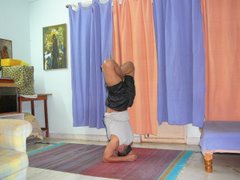
Mukta Hasta Shirshasana - variation 4
In this variation balancing is done on the elbows. This is also a standard variation (unlike the Dwi-anguli and the Tiryak versions) and a part of the Ashtanga intermediate series.
However, right now I haven't any photograph for this version. For me it is a challenging version - I find it tough to balance myself on the elbows.
I shall have myself shot doing this posture later and upload the same presently.
Sunday, February 10, 2008


Tuesday, February 5, 2008
Dwi Anguli Seershasana
Dwi Anguli Seershasana
Dwi (n.) = Two
Anguli (n.) = Finger
Seersha (n.) = Head
Asana (n.) = Posture
Well this is not a standard Seershasana posture. However, this is an approach to finally reaching the target of Nirlamba Seershasana. Which is without any hand support.
Even the dwi-anguli version feels quite tough for me!!! I am, though an old-timer in Seershasana, not that advanced - it feels :).

The weight is not balanced on exactly the tip of the fingers. So, proceed to the tip in the next photo.

Wow! the moment I try to advance to the tip, the centre of gravity changes and the body tilts to the back!


Now balanced a little more, but still a long way to go - the position does not look elegant as it should.
Dwi (n.) = Two
Anguli (n.) = Finger
Seersha (n.) = Head
Asana (n.) = Posture
Well this is not a standard Seershasana posture. However, this is an approach to finally reaching the target of Nirlamba Seershasana. Which is without any hand support.
Even the dwi-anguli version feels quite tough for me!!! I am, though an old-timer in Seershasana, not that advanced - it feels :).

The weight is not balanced on exactly the tip of the fingers. So, proceed to the tip in the next photo.

Wow! the moment I try to advance to the tip, the centre of gravity changes and the body tilts to the back!

Now balanced a little more, but still a long way to go - the position does not look elegant as it should.
Wednesday, January 30, 2008
Sanmukha Baddha Hasta Seershasana
Sanmukha Baddha Hasta Seershasana
Sanmukha (n.) = front
Baddha (adj.) = closed, interlocked
Hasta (n.) = hand, arm
Seersha (n.) = Head, top
Asana = posture
Here, in this Asana, the arms are inter-locked to the front of the head.

Below is given a close-up of the interlock structure of the arms, for a better understanding of how the arms are during the Asana.

Breathing: As usual, breathe in while raising the legs up in the air. Breathe deeply and slowly while holding the position. Hold the position for at least 5 breaths. My one slow breathing cycle takes approximately 15 seconds - of course it varies from person to person, as also it varies in my case too - As I am developing in the way of Yoga, my breathing cycle is getting longer.
Sanmukha (n.) = front
Baddha (adj.) = closed, interlocked
Hasta (n.) = hand, arm
Seersha (n.) = Head, top
Asana = posture
Here, in this Asana, the arms are inter-locked to the front of the head.

Below is given a close-up of the interlock structure of the arms, for a better understanding of how the arms are during the Asana.

Breathing: As usual, breathe in while raising the legs up in the air. Breathe deeply and slowly while holding the position. Hold the position for at least 5 breaths. My one slow breathing cycle takes approximately 15 seconds - of course it varies from person to person, as also it varies in my case too - As I am developing in the way of Yoga, my breathing cycle is getting longer.
Monday, January 28, 2008
Mukta Hasta Seershasana
Mukta Hasta Seershasana - Variation 0
This is the plain vanilla version of the Mukta Hasta Seeshasana. The other variations of Mukta Hasta provided earlier were the real variation.

Actually this is the version I had learnt first in the childhood days, even before the Baddha Hasta version and variations. Pretty easy stuff when you are trying it against a wall - that's what I did in the childhood days. hehe!
This is the plain vanilla version of the Mukta Hasta Seeshasana. The other variations of Mukta Hasta provided earlier were the real variation.

Actually this is the version I had learnt first in the childhood days, even before the Baddha Hasta version and variations. Pretty easy stuff when you are trying it against a wall - that's what I did in the childhood days. hehe!
Wednesday, January 23, 2008
Prasarita Mukta-Hasta Sirshasana
Prasarita Mukta-Hasta Sirshasana - Variariation 3
Prasarita (adj.) = extended
Pra is a prefix equivalent to latin con which is = with
Saran (n.)/(v.) = displacement by a distance (from physics, where displacement/time = speed)
Prasaran (n.)/(v.) = with displacement, hence Prasarita the adjective form means extended.

This variation of Sirshasana is slightly more challenging than the normal tripod, where the hands are closer to the head. It is quite challenging however, to move into Seershasana with your hands in the Prasarita position.
Breathing: as usual, breathe in while striking the pose. and breathe normally as you hold the pose.
Drishti: Nasagre
Prasarita (adj.) = extended
Pra is a prefix equivalent to latin con which is = with
Saran (n.)/(v.) = displacement by a distance (from physics, where displacement/time = speed)
Prasaran (n.)/(v.) = with displacement, hence Prasarita the adjective form means extended.

This variation of Sirshasana is slightly more challenging than the normal tripod, where the hands are closer to the head. It is quite challenging however, to move into Seershasana with your hands in the Prasarita position.
Breathing: as usual, breathe in while striking the pose. and breathe normally as you hold the pose.
Drishti: Nasagre
Monday, January 21, 2008
Mukta Hasta Sirshasana - Variation 2
Mukta Hasta Sirshasana - Karaprishtha variation
Kara (n.) = palm
prishtha (n.) = back
This is the back of the palm variation.

As in all Mukta Hasta Sirshasanas, weight is borne by the hands, albeit to a lesser degree. We therefore, cannot call the Mukta Hasta series as the Nirlamba series.
Nirlamba (adj.) = supportless
In the above variation, body is balanced by the wrists, and weight is also borne by them.
Drishti = Nasagre (tip of the nose)
Breathing = 1) breathe in while hoisting the legs up from the ground. 2) deep, and long and slow at the final pose 3) stay at least 5 breaths
Kara (n.) = palm
prishtha (n.) = back
This is the back of the palm variation.

As in all Mukta Hasta Sirshasanas, weight is borne by the hands, albeit to a lesser degree. We therefore, cannot call the Mukta Hasta series as the Nirlamba series.
Nirlamba (adj.) = supportless
In the above variation, body is balanced by the wrists, and weight is also borne by them.
Drishti = Nasagre (tip of the nose)
Breathing = 1) breathe in while hoisting the legs up from the ground. 2) deep, and long and slow at the final pose 3) stay at least 5 breaths
Sunday, January 20, 2008
Mukta-Hasta Sirshasana - variation1
Mukta-Hasta Sirshasana
Mukta (adj.) = free
Hasta (n.) = hand
Seersha (n.) = head, top
Asana (n.) = posture
This is a first variation of all Muktahasta Sirshasana. This free hand does not mean that weight is not borne any more by the hands. It just means that the hands are not bound together any more - as in Baddha Hasta Sirsashana.
Body weight is still borne by them, while trying to balance the body.

This is the Karatal (palm down) variation of Muta Hasta Sirshasana. Tomorrow I shall publish the Karaprishtha (palm up) variation.
<
Mukta (adj.) = free
Hasta (n.) = hand
Seersha (n.) = head, top
Asana (n.) = posture
This is a first variation of all Muktahasta Sirshasana. This free hand does not mean that weight is not borne any more by the hands. It just means that the hands are not bound together any more - as in Baddha Hasta Sirsashana.
Body weight is still borne by them, while trying to balance the body.

This is the Karatal (palm down) variation of Muta Hasta Sirshasana. Tomorrow I shall publish the Karaprishtha (palm up) variation.
<
Tuesday, January 8, 2008
Tiryak Shirshasana
Tiryak Sirshasana
Tiryak = not straight
Seersha = the head, the pinnacle
asana = posture

This is not a conventional one. Or I haven't found this asana anywhere in my limited ability or knowledge of the Asanas. I know of other variations of Shirshasana which are pretty much standard variation - but not this one.
This seems, however, a more fun sort of variation - as if you are doing some adjustments after having struck this pose, moving your legs here and there seeing how well balanced you are, and meanwhile some crazy photographer shot you in a lark. You came down and saw the result and liked it and decided to publish it and even gave it a name! :).
Well, there are challenges in here too - but they are pretty simple ones for a veteran Shirshanana fellow.
Tiryak = not straight
Seersha = the head, the pinnacle
asana = posture

This is not a conventional one. Or I haven't found this asana anywhere in my limited ability or knowledge of the Asanas. I know of other variations of Shirshasana which are pretty much standard variation - but not this one.
This seems, however, a more fun sort of variation - as if you are doing some adjustments after having struck this pose, moving your legs here and there seeing how well balanced you are, and meanwhile some crazy photographer shot you in a lark. You came down and saw the result and liked it and decided to publish it and even gave it a name! :).
Well, there are challenges in here too - but they are pretty simple ones for a veteran Shirshanana fellow.
Subscribe to:
Posts (Atom)