Showing posts with label Yoga for Hypothyroidism. Show all posts

Friday, May 9, 2008

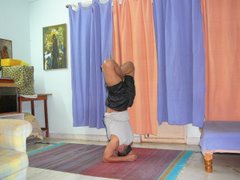
Sarvangasana

Sarvangasana

Sarva (n.) = All
Anga (n.) = Limb
Asana (n.) = Posture

Together these words will mean the posture which exercises all limbs

 
Posted by Picasa


Self Critique:

Well, thanks to my back pain which is almost gone now, I have not been doing this Asana or any other forward bending Asana for a long time. As I reported sometime earlier, I recently started doing Sarvangasana regularly. But years of non-practice has led to reduce the quality that I seek in everything. First defect in this posture that I see, that the body is not as perpendicular to the ground as I would like it to be. Second, the weight of the body is still borne by wrists and hands here - the force applied by the hands and the waists can be clearly seen. Ideally, the palms should merely rest on the back, they should not exert pressure of the waist to hold the torso straight.

Breathing: Breathe in as you raise the legs to the position, breathe normal as you hold the position, and breathe out as you lower the limbs to the ground.

How to execute the posture:

1) Lie in Savasana
2) perform Ardha halasana
3) Raise your back from the ground with the help of the hands and legs moving from Ardha halasana without resting and in one sweeping motion


Wednesday, February 27, 2008

Asanas Fighting Hypothyroidism

Visitors coming to this this site looking for Hypothyroidism fighting Asanas.

Best approach would be: to go to a Yogacharya who specialises in Therapeutic Yoga. Someone like Yogananth - who, despite his being so young has attracted admiration from all corners, including mine. :)

Here is his official site http://www.yogananth.com/

Well,if you are looking for a ready reckoner, in my limited knowledge of the Yoga postures, let me give the following Asanas which would be good in fighting Hypothyroidism.

Matsyasana
Ardha Chakrasana
Greevasana / Viparita Dandasana
Setubadhasana (Shirsha-Pada-Bhumi-Sparshasana)

Ushtrasana

To be complemented by the following Asanas

Kavandhasana
Halasana
Sarvangasana
Sasangasana


Pranayama
Ujjayee pranayama(Jalandharbandha),

Tuesday, February 26, 2008

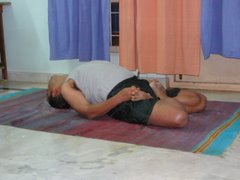
Matsyasana - the plain vanilla one

Matsyasana - the plain vanilla version


Over the last three posting I progressed from the Saral version of Matsyasana to this version of Matsyasana, which is the most standard version.

However, there is a more difficult version too, which I am not able to do as of now, may be in about two years in future I shall be able to do it. That is the Baddha Padma version - which is: perform a Baddha Padmasana , then perform Matsyasana.


Drishti: Nasagre, or Bhru-Madhye

Breathing: As you raise your body from the floor and go into Matsyasana, inhale. Breathe normally as you hold the posture.

Benefits: Matsyasana is one of the Asanas that benefits hypothyroidism cases to a good extent. To achieve the full benefit, however, a complementary Asana - that is one of the following Asanas: Sasangasana, Sarvangasana, or Kavandhasana/Kandharasana needs to be executed.

Of all the above Asanans I have posted only the Kandharasana, which is also known as Kavandhasana, in this blog.

Posted by Picasa


Friday, December 28, 2007

Shirsha-Pada-Bhumi-Sparshasana

Shirsha-Pada-Bhumi-Sparshasana

Shirsha = the top, the crown
pada = the legs
Bhumi = the ground, earth
Sparsha = touch
Asana = posture

If we piece the above words together it will mean - Touching the ground by the head and the feet through this posture.

This is slightly tougher than the Greevasana

Shown below is the nirlamba (unsupported) version


However, once we are comfortable with Greevasana, this is doable. I practise this Asana on earth - the bank of a small lake we have at our neighbourhood. I find it easy there, since the soft grass on the ground (in the morning hours the earth is also soft, washed with dew drops) has lots of friction to help me balance my body a lot more.

Warning!!:

Practise this Asana only when your neck muscles are strong enough to support your body weight.

Posted by Picasa

Thursday, December 20, 2007

Greevasana - Part 2

Greevasana

Greeva (n.) = Neck
Nirlamba (adj.) = Unsupported


This is the nirlamba version of the Greevasana. The pressure on the neck of the whole body without the forearms sharing it. The asana gives a sweet pain, as the back of your head touches your back

Warning:

Don't do it without having done the salamba version (supported) for over an extended time. You may hurt your neck, if you are trying it if your neck muscles are not that strong.

My next goal:

The goal is for the Salamba version. Execute a Shirshasana from the Salamba Greevasana. And then from Shirshasana do a Vrischikasana (scorpion) and a pincha mayurasna


Posted by Picasa

Tuesday, September 11, 2007

Yoga for Back Pain (Concluding Part) - Ardha Chakrasana

Ardha Chakrasana (the Arch)

Ardha = half
Chakra = wheel, or the disc used as weapon by Krishna, the character in Mahabharata the epic of India


Self-critique: I am no good at all in this asana. Culprit is my poorly joined left arm after a near fatal accident quite a long time ago. As also some kind of nodular problem in the tendon sheath of the right wrist - which makes it very difficult and painful to support my body weight on the right wrist. Hence the arms are never straight as they should be. Hopefully Yoga will help me get over these problems in time to come.

Comments: This concludes the back pain series in Asana. Exclusions are the pranayama part. I did not intend to cover them in this series though they are as effective, if not more, in relieving back pain.

Saturday, September 8, 2007

Yoga for Back Pain (Part20) - Kavandhasana

Kavandhasana

This asana is easier version of the Ardha Chakrasana. People who find difficult to do the Arch (Ardha chakrasana) could do this.

Kavandha (n.)= headless torso.


Some call this Kandharasana = shoulder Asana. Apart from back pain, this Asana is good for Hypothyroidism too. Since it exerts pressure on the thyroid glands.

The shoulder Stand, Sarvangasana too does the same and of course does something more - which is: help the flow of blood to the neck and face region. But then people with back pain must not do a shoulder stand. I did, that for a long time :). And suffered because of this folly. :).

Tuesday, July 31, 2007

Yoga to Get Rid of Back Ache - Part 1


Ushtrasana (The camel pose)

Anurag posted to say that he too wanted to get rid of the back ache. I suppose there could be many who want to do that.

I thought let me come out with a series of yoga postures that helped me immensely, and that they could perhaps be helpful to all others too.

But first, let me publish the necessary warnings. I am no Yoga instructor, only a student - though some may say that I am an intermediate level student, learning some advanced postures these days. So, the value of a Yoga instructor, who specializes in therapeutic yoga is never discounted. Below is published the checklist for back-cure.

Step1: Talk to your orthopaedist. Have her review your spinal condition. If it's not slip disk, or some other grave spinal condition then proceed to step2. If you have them, talk to a yoga acharya who specialises in Yoga therapy to cure disease.

Step2: Remember never ever to do any forward bending Asana during Yoga as long as you have back-ache.

Step 3: Depending on the gravity of the pain (the more intense the pain the less you proceed beyond the first few) you do the following Asanas:

1) Kati-Uttanasana - the waist tilting
2) Markatasana / Udarakarshanasana (there are three varieties - if pain is grave, do not do the 2nd and the 3rd variety)
3) Utthita padasana (one leg and both legs both are good) - Leg Raise
4) Ardha halasana - Another form of leg Raise
5) Supta Padangushthasana
6) Nasa Sparshasana
7) Pavan Muktasana (one legged and two legged)
8) Tolangulasana

Next week (I get a chance to photograph myself only during the weekends), I would publish the photographs of the above asanas.

There are backbending Asanas too which help get rid of the back pain - but they all come with necessary warnings or contraindications.

I would talk about them much later in this series.

The camel pose above is one such asana